Understand the core difference first
When comparing custom Quran academy software vs ready-made SaaS, the central question is how the system comes into being. Custom software is commissioned around an agreed scope and implementation arrangement. Ready-made Quran academy software is an existing product that customers configure and access under the provider's available plans, features and terms.
Neither model is automatically better. Custom software vs SaaS for Quran academies is a decision about fit, responsibility and long-term priorities. The right choice depends on academy size, workflow complexity, budget, timeline, available technical support and future plans. Start with those conditions before comparing feature lists or sales presentations.
A practical custom-versus-SaaS comparison
This table describes typical differences, not promises. A particular proposal or product may handle each area differently, so verify the details before deciding.
| Decision area | Custom software | Ready-made SaaS |
|---|---|---|
| Initial cost | Usually requires upfront discovery, design, development, testing and implementation work. | Usually starts with a recurring plan and may include separate setup, migration or add-on costs. |
| Setup speed | Requires scope decisions and an implementation period before the approved system is ready. | Can often be configured sooner when the academy fits the product's established workflow. |
| Workflow fit | Can be designed around approved roles, records and processes within the agreed scope. | Provides configurable options within the boundaries of a product built for many customers. |
| Ownership and control | Code, hosting and intellectual-property rights depend on the signed delivery agreement. | The vendor generally controls the product; customer rights depend on terms and data policies. |
| Maintenance | Maintenance responsibility must be assigned to the academy, developer or another agreed provider. | The vendor normally maintains the shared product and chooses its update schedule and roadmap. |
| Integrations and migration | Required connections and data migration can be scoped after technical feasibility is assessed. | The academy works with the imports, exports and integrations that the vendor supports. |
| Scaling | Capacity and future expansion depend on architecture, hosting and continued technical support. | Expansion may be convenient through plan tiers, subject to product limits and commercial terms. |
Compare initial cost with recurring cost
A custom project usually concentrates more cost around discovery, interface planning, development, testing, deployment and initial adoption. Later costs can include hosting, maintenance, support and approved changes. The total cannot be judged honestly without a defined scope, delivery arrangement and understanding of who remains responsible after handover.
SaaS commonly spreads cost through recurring subscription terms. The practical total may depend on users, students, usage tiers, optional modules, migration or support. Compare both approaches across a realistic planning horizon, including switching and staff time, without assuming either model will always be cheaper.
Compare proposals with the same assumptions: required roles, active records, data preparation, support expectations and likely changes. Include the academy team's implementation time as well as vendor charges. A low headline cost can be misleading if staff must keep parallel records or purchase additional services to complete the workflow.
Setup speed and implementation responsibility
Ready-made SaaS is often the faster route when the academy can work within the product's structure. Configuration, data preparation, permissions and staff orientation still require ownership, but the underlying product already exists. A reputable provider may also offer established documentation and support processes.
Custom development takes time because requirements must be understood and decisions must be tested. The academy needs someone who can answer workflow questions, review work and prepare data. A realistic schedule should include implementation and team adoption, not only the period spent writing code.
Whichever route is chosen, plan a controlled introduction. Verify user roles, test representative records, document essential tasks and decide who responds when staff encounter a problem. Faster access to a product does not remove the need for careful setup, while a longer custom project does not guarantee adoption without clear operational ownership.
Workflow fit and meaningful customization
Ready-made products work well when their student records, roles, schedules and reports are close to the academy's needs. Configuration can provide useful flexibility without the cost and responsibility of commissioning a system. The trade-off is that the academy may need to adapt some processes to the product.
Custom software can reflect approved workflows more closely, but every variation adds decisions, testing and maintenance. Distinguish a genuinely important process from a preference that the team could simplify. Useful customization removes recurring friction; unnecessary customization can make a system harder to deliver and support.
Ask teachers and administrators to walk through real examples before accepting a feature as essential. A workflow diagram, sample report or trial configuration can expose assumptions early. This evidence helps an academy decide whether to adapt its process, configure an existing product or include a requirement in a custom scope.
Ownership, data control and contract terms
Quran academy software ownership and customization should be discussed explicitly. With custom development, source-code rights, intellectual property, deployment access, documentation and the ability to appoint another provider all depend on the signed contract and delivery arrangement. Paying for development does not by itself answer every ownership question.
With SaaS, the vendor generally owns and operates the product while the academy uses it under agreed terms. Review how data can be accessed and exported, what happens when a subscription ends, and which responsibilities remain with the academy. These are commercial and legal considerations; this guide is not legal advice.
Hosting, security, privacy and maintenance
Greater hosting control also brings greater responsibility. A custom arrangement needs clear ownership for deployment, access management, updates, backups, monitoring expectations and incident response. Those duties may sit with the academy, a developer or another provider, but they should not be left undefined.
Reputable SaaS providers can offer strong security practices, ongoing maintenance and dependable support. The academy should still assess relevant policies, account controls, data locations, backup arrangements and incident processes. Privacy and safeguarding obligations vary by circumstance and location, so obtain qualified guidance where necessary.
Integrations and data migration
List essential integrations before comparing options. A custom build can scope suitable connections after technical access and feasibility are confirmed. A SaaS product may provide supported connections or documented import and export methods. In both cases, an integration should solve a verified hand-off rather than add complexity without a clear owner.
Data migration deserves its own plan. Existing spreadsheets and records may contain duplicate entries, inconsistent fields or missing information. Decide what must be moved, who will clean it, how results will be checked, and which historical material can remain archived instead of entering the new system.
Support, updates and vendor dependency
SaaS customers benefit when a capable vendor maintains and improves the shared product. The trade-off is dependence on that provider's availability, roadmap, pricing structure and terms. Ask how support is delivered, how changes are communicated and how usable data can be recovered if the academy later moves.
Custom software does not remove dependency; it changes its form. The academy still needs people who can maintain the application, hosting and documentation. A clear handover and support arrangement can reduce uncertainty, but ongoing technical capability must be planned and funded.
Plan for realistic growth scenarios
Growth may mean more students, teachers, courses, administrators or branches. A ready-made platform can make expansion straightforward when its plans and supported structure match those needs. Check how user limits, permissions, reporting and data separation work before assuming a higher plan solves every operational issue.
A custom system can be planned around likely growth, but scalability is not automatic. It depends on architecture, hosting, data design, testing and continued maintenance. Base decisions on credible scenarios rather than building complex capabilities for growth the academy has not yet defined.
Write down the next realistic growth step and test both options against it. For example, consider how a new teacher, course or administrative location would be added, who could view its records and whether reporting remains clear. Specific scenarios are more useful than a general promise that a system can scale.
Which approach is more practical?
Choose ready-made SaaS when
Workflows are reasonably standard, setup speed matters, internal technical capacity is limited, and a suitable provider's features, support and terms meet the academy's needs. Off-the-shelf Quran academy software may then be the more practical and lower-friction choice.
Evaluate custom development when
Core workflows do not fit available products, roles or reporting are materially different, or essential integrations require a tailored approach. A bespoke Quran academy management system may be justified only when the operational value supports the added cost, time and responsibility.
Consider a phased or hybrid path
An academy can begin with a suitable existing product while clarifying its processes, or retain proven tools while evaluating a focused tailored component. Define boundaries carefully so the hybrid approach does not create duplicate records or unclear ownership.
A practical build-versus-buy checklist
Use these build vs buy academy software questions with decision-makers before requesting proposals or selecting a subscription.
- Which academy workflows are genuinely different from standard education administration?
- How quickly must the team begin using a more structured system?
- Can the budget support upfront implementation, recurring fees, or a considered mix of both?
- Who will own implementation decisions, data preparation and staff adoption?
- What do the proposed contract or subscription terms say about code, data, access and exit options?
- Which integrations and historical records are essential, and which can wait?
- What support will be available after launch or subscription setup?
- How might student, teacher, course or branch needs change over the planning horizon?
See a working LMS concept
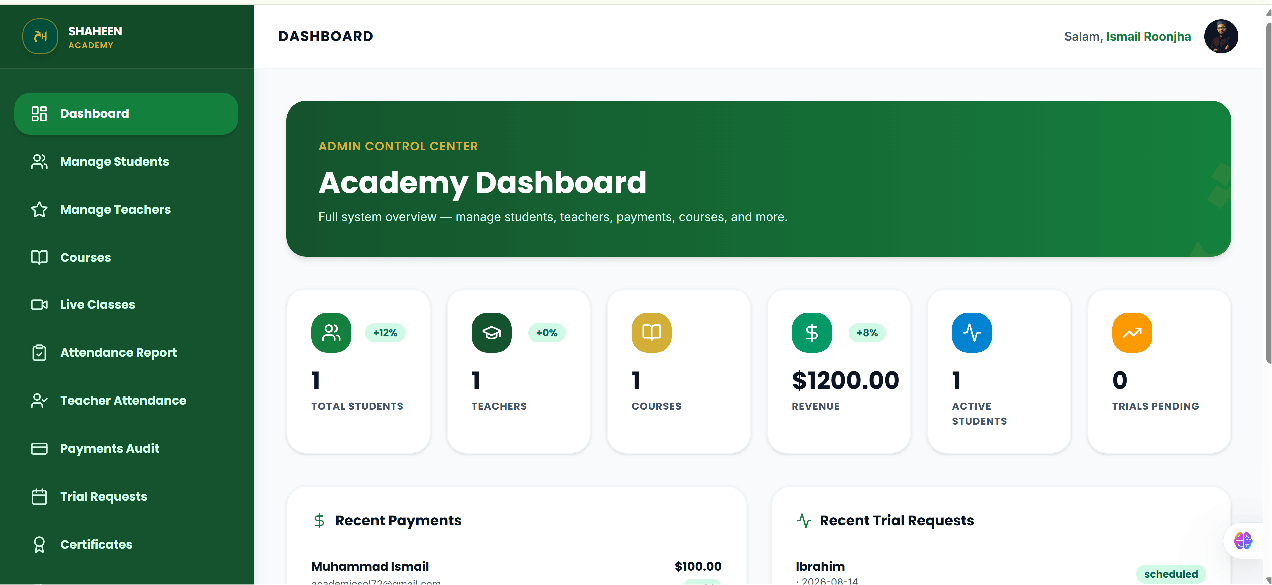
The dashboard below is working project proof from the Shaheen Quran Academy LMS concept. It demonstrates student, class and administrative workflows; it is not a paid client delivery or a commercial SaaS product. You can explore the Shaheen Quran Academy working LMS project to review its documented scope.
Continue the evaluation with practical context
Before choosing a system, clarify the underlying process in our guide to managing an online Quran academy and compare capabilities with the Quran academy management software features checklist.
Make the decision from evidence, not assumptions
Ready-made SaaS can be a strong choice when it fits the academy and reduces the burden of running technology. Custom development can be appropriate when documented needs justify its additional responsibility. Compare real workflows, proposals, terms and support arrangements before deciding.
If a tailored route remains worth investigating, review how Shaheen Developers approaches an academy software development project with scope defined around operational requirements.